Showing posts with label mushroom photography. Show all posts
Friday, July 12, 2019
Golden Chanterelle
Smooth and Golden Chanterelles, Pittsburgh, PA 2019
Well, I posted a couple of days ago about discovering smooth chanterelles while on a hike, with the intent to return and pick more to serve with a meal. And, we did return, only this time we found many more golden chanterelles, Cantharellus cibarius, growing nearby. I knew that though the mushrooms looked nearly identical, that the goldens were not the smooths because all identification sources insisted that smooth chanterelles have a solid stem, no quibbling about it. I discovered that goldens, yes, have a hollow stem, and it peels apart fibrously, like string cheese. Also note that both varieties of chanterelle have the tell-tale false gills. Please, if ever hunting mushrooms in the wild to eat, be sure of your identification. A mistake can be, and often is, deadly.
Labels:
golden chanterelle,
mushroom photography
Wednesday, July 10, 2019
Smooth Chanterelle
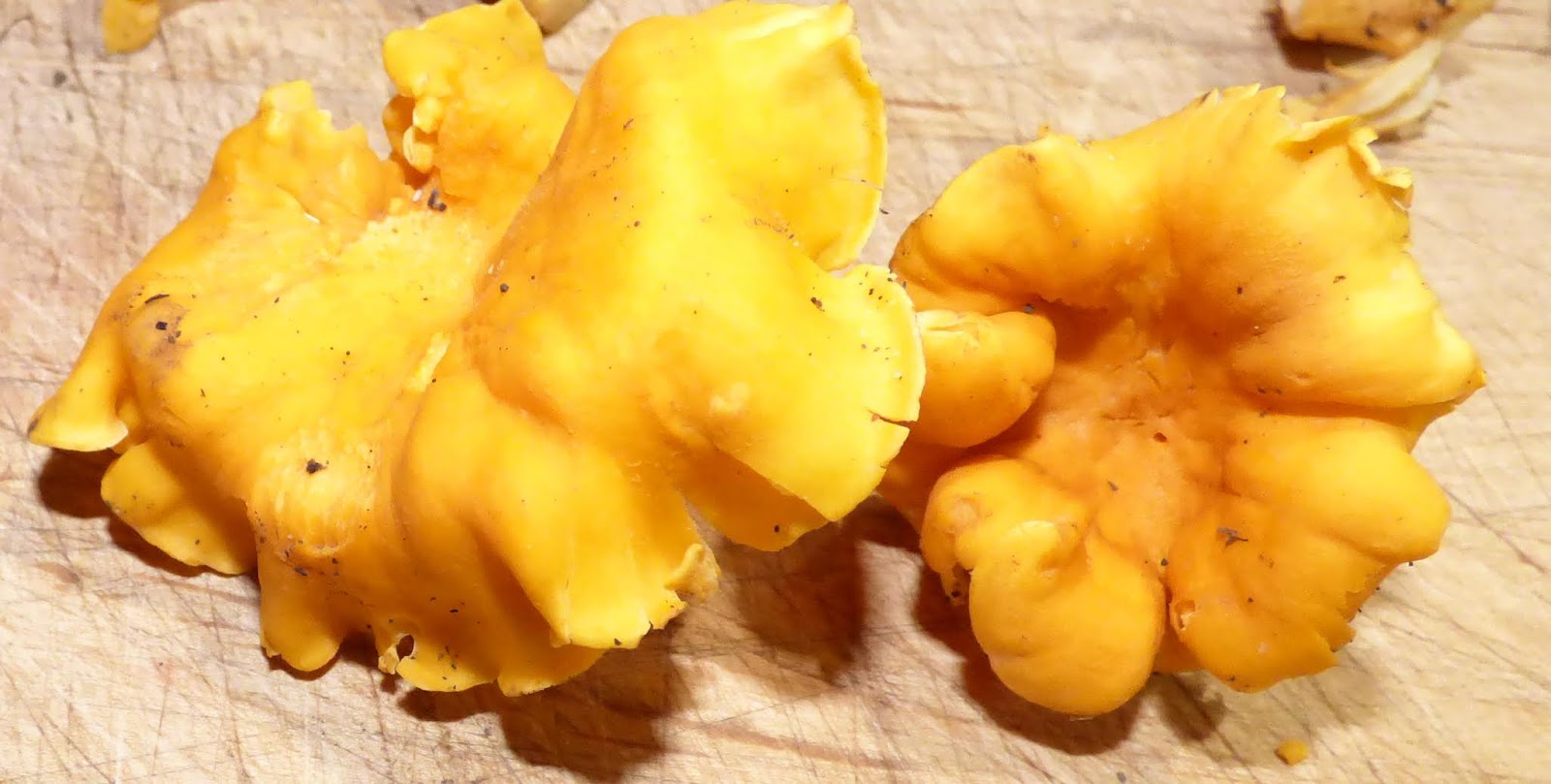
Cantharellus lateritius, Smooth Chanterelle Mushroom, Pittsburgh 2019
Sometimes, if you're lucky, you may wander so deep into a forest that it - and you - feel primeval. Yesterday my wife and I found ourselves in just such a mental and physical space. Up to our knees in mud, bare legs and arms stung by nettles, somehow impossibly the sweet scent of peaches hanging in the humid air.
Late on the trail, crossing a heavy flowing run, on the opposite bank, a bright yellowish orange mass winked from beneath green foliage. The top of the mushroom was shiny, but not slimy, and when I picked one and turned it over, I immediately noticed the false gills running down the stem. Without an identification book to consult, I could guess that it was a chanterelle, but not know for sure, so I brought one home with me. Further research revealed that it was indeed a smooth chanterelle, and that it is one of the most choice wild mushrooms to be had.
Often I identify mushrooms I find on walks and hikes, and even though sometimes the mushrooms are edible, I usually only pick and eat wild mushrooms when I'm foraging with our close friend and expert, Al. Only one other time have I eaten what I collected, and that was a meadow mushroom, the common wild variety of the ubiquitous store bought button mushroom. With this find my curiosity grew as I read how to best prepare chanterelle mushrooms. Most recipes called for sauteeing in butter, but one said to start in a hot dry pan to render the water from the mushrooms and allow it to cook off, and then add the butter. Which is exactly what I did, and the results blew me away. Easily the most delicious mushroom I've ever tasted, and why we're returning to the scene this morning to collect more for dinner tonight. Prepared as before, then tossed with linguini in the pan and plated, with Alfredo sauce added at the end. I picked fresh lettuce first thing this morning, so I'm set.
Sometimes, if you're lucky, you may wander so deep into a forest that it - and you - feel primeval. Yesterday my wife and I found ourselves in just such a mental and physical space. Up to our knees in mud, bare legs and arms stung by nettles, somehow impossibly the sweet scent of peaches hanging in the humid air.
Late on the trail, crossing a heavy flowing run, on the opposite bank, a bright yellowish orange mass winked from beneath green foliage. The top of the mushroom was shiny, but not slimy, and when I picked one and turned it over, I immediately noticed the false gills running down the stem. Without an identification book to consult, I could guess that it was a chanterelle, but not know for sure, so I brought one home with me. Further research revealed that it was indeed a smooth chanterelle, and that it is one of the most choice wild mushrooms to be had.
Often I identify mushrooms I find on walks and hikes, and even though sometimes the mushrooms are edible, I usually only pick and eat wild mushrooms when I'm foraging with our close friend and expert, Al. Only one other time have I eaten what I collected, and that was a meadow mushroom, the common wild variety of the ubiquitous store bought button mushroom. With this find my curiosity grew as I read how to best prepare chanterelle mushrooms. Most recipes called for sauteeing in butter, but one said to start in a hot dry pan to render the water from the mushrooms and allow it to cook off, and then add the butter. Which is exactly what I did, and the results blew me away. Easily the most delicious mushroom I've ever tasted, and why we're returning to the scene this morning to collect more for dinner tonight. Prepared as before, then tossed with linguini in the pan and plated, with Alfredo sauce added at the end. I picked fresh lettuce first thing this morning, so I'm set.
Thursday, March 24, 2016
Mushroom ID
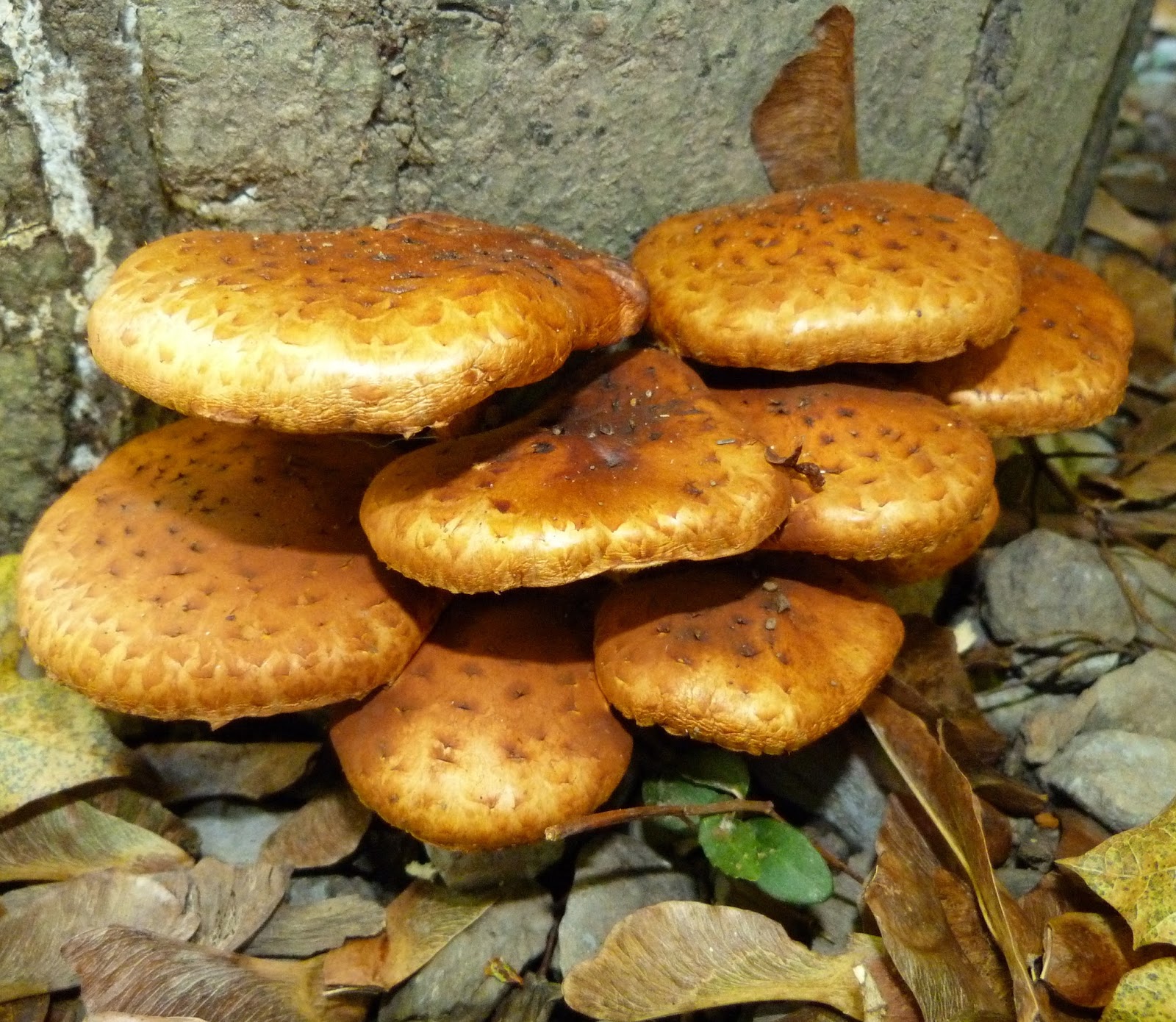
Pholiota aurivella, Golden Scaly Cap Mushroom, Inedible
I was having a very difficult time identifying this mushroom and took to shroomery.org for help. Literally within minutes someone pointed me in the right direction. In the mushroom identification books I have they don't focus on that scaly top, which you kind of have to do because it's truly a dead give away. One thing I've learned about the most helpful identification books is that an illustration often serves better than a photograph because an illustration can pay special attention to a a certain feature unique to a species.
Saturday, February 27, 2016
Turn Tail And Run With It
Trametes versicolor, dorsal and ventral views, Pittsburgh, Feb., 2016
Growing on a Norway Maple (Acer platanoides) stump in the backyard is a colony of turkey tail polypores (Trametes versicolor). I cut one free and brought in to do a photo study of it. A fine specimen, pliable and fresh, as with age they tend to become woody and hardened. Then, I started to do a bit of digging into the function and uses of T. versicolor. Times like these the internet is really a wondrous thing, such a wealth of information, things that the identification books don't provide. Of course, you still have to be wary of where and how you get your information, and the veracity of the claims made. Just because it's on the internet doesn't make it accurate.
I was surprised to discover that T. versicolor has been widely studied in Japan, China, and South Korea as a cancer treatment, most specifically for stomach, colorectal, esophageal, and breast cancers. My thinking with mushrooms and assorted fungi in the treatment of any ailment, is that it is most effective as a preventative measure, to keep you from getting a disease in the first place.
I'm going to dry some T. versicolor and make a tea of it. The rule of thumb with mushroom teas is that 1 ounce of dried mushrooms produces 1 gallon of tea.
Monday, October 19, 2015
Distracted by Mushrooms
Pholiota limonella, Pittsburgh, October, 2015
While splitting wood I noticed a cluster of mushrooms growing on the base of the chopping block. This served to provide me with the merest of distractions and I set aside the axe and took up 'Peterson' Field Guide to Identifying Mushrooms'. While not entirely useless, it did lead me down a couple of wrong paths and one blind alley. Forced to use broad, descriptive terms on google images, I finally fell upon a site that helped me properly identify the fungi (hopefully, it's poisonous anyway, so it's not like there's some sort of culinary calamity awaiting). It is Pholiota limonella, and this opinion is reinforced by the fact that the mushroom does indeed make a rusty spore print. I should've photographed the spore print to include here, but I'm recharging my camera battery right now.
Nothing left to do but get back to splitting those logs.
Subscribe to:
Posts (Atom)