Wednesday, October 28, 2015
Musk Mallow
Musk Mallow Flower and Seeds, Malva moschata, Pittsburgh, 2015
Musk mallow grows wild and thrives best in the shaded parts of my yard. This year I collected the seeds pods and was pleasantly surprised by their unique shape. The leaves, flowers and seeds of the plant are all edible, but the plant is most prized (as are all mallows) for their medicinal uses.
Labels:
malva moschata,
musk mallow,
seeds
Sunday, October 25, 2015
Landscapes
Slippery Rock Gorge, Kildoo Trail, McConnells Mill State Park, PA, 2015
Sunset, Prime Hook National Wildlife Refuge, DE, 2014
These are the other two landscapes that my wife chose to hang in her classroom. I hope she likes them because I ordered very large prints.
Sunset, Prime Hook National Wildlife Refuge, DE, 2014
These are the other two landscapes that my wife chose to hang in her classroom. I hope she likes them because I ordered very large prints.
Of Landscapes and Inspiration
Maine Shoreline, Acadia National Park, 2011
My spousal unit has requested some prints for her classroom. Of course she doesn't want anything too crazy, so I'm working on some landscapes that will hopefully inspire the students. Yes, whenever anyone thinks of my photography, they immediately think of inspiration.
Self deprecation aside, going back through the photo journals of our travels reminds me of how photography captures the moment. I am transported back to the time we were there, which feels closer in time than four years ago, as with the above picture of Maine. It's hard to believe that it has been four years. It feels so much more immediate. Ah well. We're planning on a return trip to Maine and Acadia National Park in the summer of '17. Got to get there while we're still spry enough to do the really difficult hikes.
My spousal unit has requested some prints for her classroom. Of course she doesn't want anything too crazy, so I'm working on some landscapes that will hopefully inspire the students. Yes, whenever anyone thinks of my photography, they immediately think of inspiration.
Self deprecation aside, going back through the photo journals of our travels reminds me of how photography captures the moment. I am transported back to the time we were there, which feels closer in time than four years ago, as with the above picture of Maine. It's hard to believe that it has been four years. It feels so much more immediate. Ah well. We're planning on a return trip to Maine and Acadia National Park in the summer of '17. Got to get there while we're still spry enough to do the really difficult hikes.
Tuesday, October 20, 2015
Vemodalen And Us
Giant Rubber Duck, Pittsburgh, September 2013
The Dictionary Of Obscure Sorrows defines Vemodalen thusly: n. the frustration of photographing something amazing when thousands of identical photos already exist. Yes, I cannot tell you the creeping futility I sometimes experience while photographing something that is uncommon, rare, beautiful, decayed and collapsing in on its own weight, or even just delightfully whimsical - all with the realization that it's been captured by camera before, and will again.
Case in point: Two years ago when Dutch artist Florentijn Hofman's duck colossus was launched on the Allegheny River in Pittsburgh, people flocked to the Point (where the fountain is), and to Mount Washington overlooking the city (where I was here) to get a good shot of the Duck. I took a lot of photos because digital costs nothing and bad shots can be deleted. Not having to rely on film and all of the expense incurred with film photography has made photography extremely accessible, but at the same time ubiquitous and devalued.
I ended up with some really wonderful images of the city and the duck colossus and spoke to the owner of the gallery that carries my work to see how many prints I should bring in...None, as it turned out. The duck colossus was everywhere, had saturated the market, and no matter how great my work was, it was still of the Duck.
If you are in need of a prompt for an existential crisis, The Dictionary of Obscure Sorrows has a youtube channel, and this is their entry on the subject of Vemodalen.
I won't stop photographing things, nor will I fall into too deep a pit of despair about the futility of it all, but it still gives me pause. What am I doing and what does it mean?
The Dictionary Of Obscure Sorrows defines Vemodalen thusly: n. the frustration of photographing something amazing when thousands of identical photos already exist. Yes, I cannot tell you the creeping futility I sometimes experience while photographing something that is uncommon, rare, beautiful, decayed and collapsing in on its own weight, or even just delightfully whimsical - all with the realization that it's been captured by camera before, and will again.
Case in point: Two years ago when Dutch artist Florentijn Hofman's duck colossus was launched on the Allegheny River in Pittsburgh, people flocked to the Point (where the fountain is), and to Mount Washington overlooking the city (where I was here) to get a good shot of the Duck. I took a lot of photos because digital costs nothing and bad shots can be deleted. Not having to rely on film and all of the expense incurred with film photography has made photography extremely accessible, but at the same time ubiquitous and devalued.
I ended up with some really wonderful images of the city and the duck colossus and spoke to the owner of the gallery that carries my work to see how many prints I should bring in...None, as it turned out. The duck colossus was everywhere, had saturated the market, and no matter how great my work was, it was still of the Duck.
If you are in need of a prompt for an existential crisis, The Dictionary of Obscure Sorrows has a youtube channel, and this is their entry on the subject of Vemodalen.
I won't stop photographing things, nor will I fall into too deep a pit of despair about the futility of it all, but it still gives me pause. What am I doing and what does it mean?
Monday, October 19, 2015
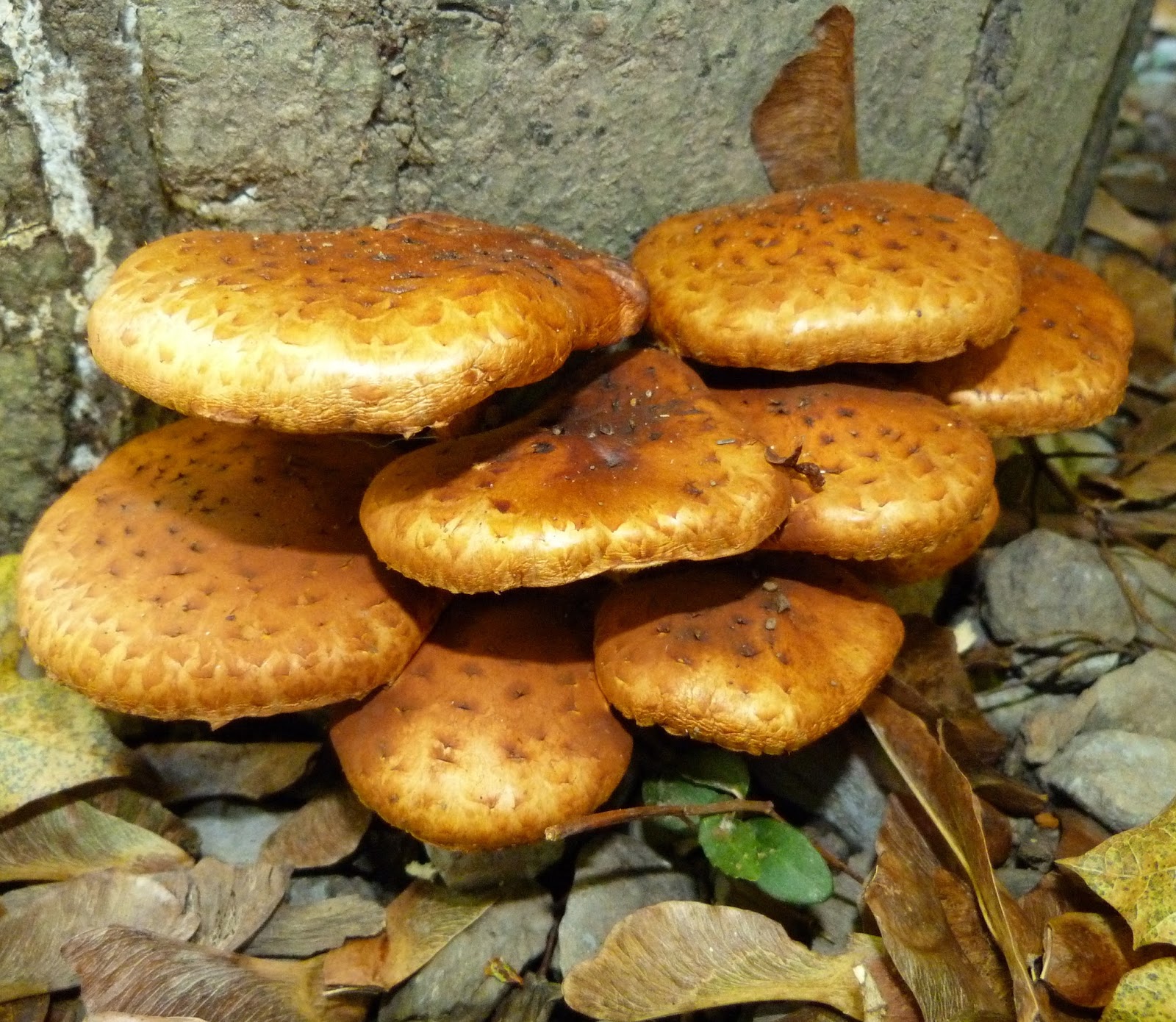
Distracted by Mushrooms
Pholiota limonella, Pittsburgh, October, 2015
While splitting wood I noticed a cluster of mushrooms growing on the base of the chopping block. This served to provide me with the merest of distractions and I set aside the axe and took up 'Peterson' Field Guide to Identifying Mushrooms'. While not entirely useless, it did lead me down a couple of wrong paths and one blind alley. Forced to use broad, descriptive terms on google images, I finally fell upon a site that helped me properly identify the fungi (hopefully, it's poisonous anyway, so it's not like there's some sort of culinary calamity awaiting). It is Pholiota limonella, and this opinion is reinforced by the fact that the mushroom does indeed make a rusty spore print. I should've photographed the spore print to include here, but I'm recharging my camera battery right now.
Nothing left to do but get back to splitting those logs.
Thursday, October 15, 2015
Natural History Museum (London) Wildlife Photography Winners
Edwin Giesbers, Crested Newt, Reptile/Amphibian Winner
It's that time of year again, when the Natural History Museum in London announces their wildlife photography winners. Photos submitted from around the globe compete in categories ranging from reptile/amphibian, urban wildlife, underwater, from the sky, young photographer, to the overall grand prize winner.
I chose to highlight Edwin Giesbers' shot over the grand prize winner Don Gutoski's "A Tale of Two Foxes" because of the trees. Notice the gaps between each tree's foliage? That's known as 'canopy shyness' and it is how trees evolved to share space and thrive. I first learned about canopy - or crown - shyness from a blog post on TYWKIWDBI a month ago, and it's why I knew exactly what I was seeing serving as a backdrop to the crested newt suspended in a pond. Giesbers donned a wetsuit and remained very still while submerged to get this perfect shot from beneath.
It's that time of year again, when the Natural History Museum in London announces their wildlife photography winners. Photos submitted from around the globe compete in categories ranging from reptile/amphibian, urban wildlife, underwater, from the sky, young photographer, to the overall grand prize winner.
I chose to highlight Edwin Giesbers' shot over the grand prize winner Don Gutoski's "A Tale of Two Foxes" because of the trees. Notice the gaps between each tree's foliage? That's known as 'canopy shyness' and it is how trees evolved to share space and thrive. I first learned about canopy - or crown - shyness from a blog post on TYWKIWDBI a month ago, and it's why I knew exactly what I was seeing serving as a backdrop to the crested newt suspended in a pond. Giesbers donned a wetsuit and remained very still while submerged to get this perfect shot from beneath.
Wednesday, October 14, 2015
Beyond the Catdoor
Pepe The Cross-Eyed Cat, Pittsburgh, 2015
To keep the dog out of the cat box in the basement, we installed a catdoor. Perhaps a common sense approach and not so remarkable. But, the manner in which Pepe sneaks up on the catdoor, and then bursts through like he's traveling through time or dimensions, does make it hugely entertaining. I like to think that there's a parallel Cat Kingdom on the other side of that kitty portal, ruled by a foul-tempered (and foul-smelling) one-eared Tom, with intrigue and betrayal at every turn. I'm integrating this premise into my memoir because I need more filler.
Labels:
cat door,
cat kingdom,
interdimensional cat travel
Subscribe to:
Posts (Atom)